
Using other outdated ERP software, you are forced to set up cost account codes like these:
inventory-item2-lot3-bin4and the number of your cost accounts keeps growing to more than 100,000.
Your database is thus huge and the ERP software server running on a high end hardware server slowly responds to a few users.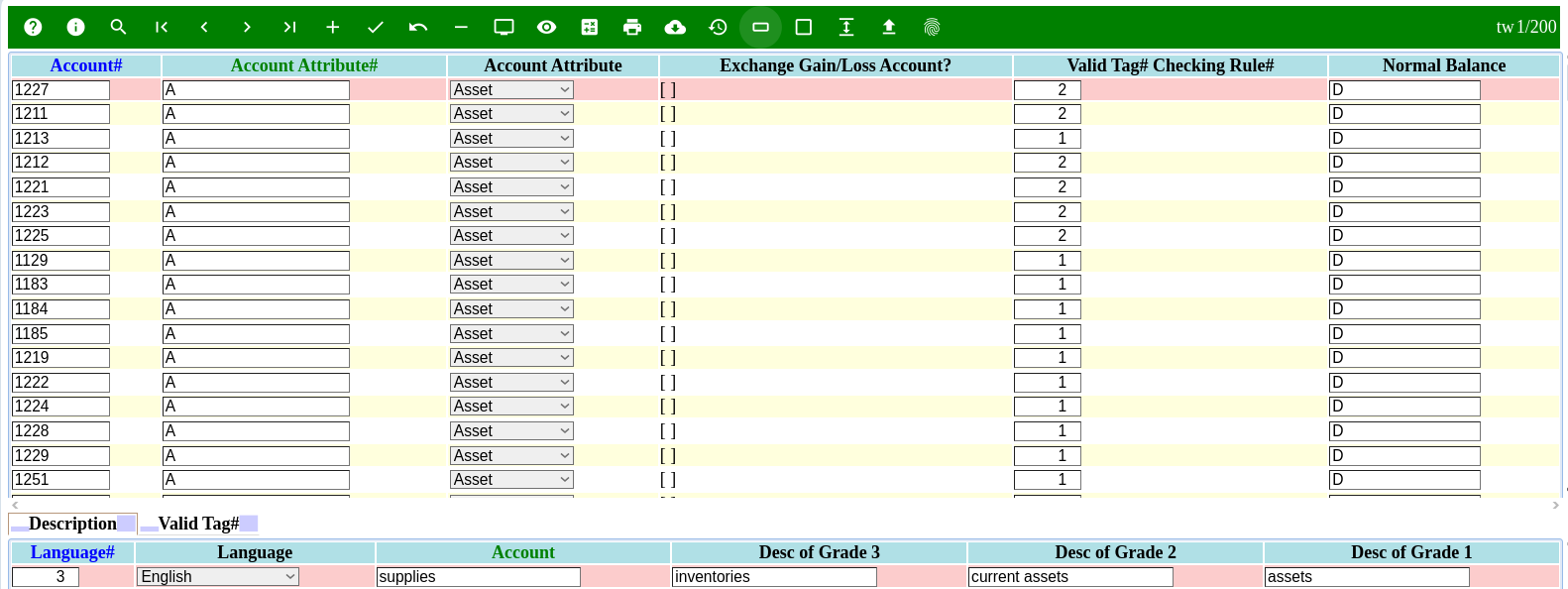
PostERP not only does not require you to set up account codes with multiple sub-segments, but it also discourages you from doing so.
Using PostERP, your group can use only one chart of basic accounts, where each account code is a basic account with one segment like these:
1110: inventoryNone of the following information is incorporated in your chart of accounts:
Item#Your chart of accounts is likely to remain nearly constant for years.
Taking the Universal Manufacturing edition as an example, PostERP uses the Taiwan government-provided "Accounting Subjects Chinese-English Comparison and Coding" with only 359 subject numbers.
You don't waste time mapping different charts of accounts between your subsidiaries in your group.That's is one of the reasons why your PostERP database size is tiny and PostERP server runs in a mediocre hardware server and responds at lightning speed to thousands of concurrent users.
You get up-to-date financial information including all financial statements anytime nearly instantly because the PostERP server simply executes under the hood only ONE "SELECT …… FROM ……" statement to read only a few accounting journal PostgreSQL tables.
PostERP doesn't execute the slow, complicated and bloated programs written in procedural languages like ABAP, Python, Developer/2000, C# or Java.